Quick help
Rocket multiplier flight simulation
- Choose a practice bet and Launch. The faster multiplier doubles every 1.75 seconds along a pre-resolved flight.
- The same primary button becomes Bank. Press it before the neutral “flight ended” result to return bet × multiplier.
- The idealized distribution returns 94% before its 250× cap. Reaching the cap forces a successful maximum bank.
- The shared Pause control, a hidden tab, or window blur freezes elapsed time without changing the resolved ending.
Controls: Select bet · Launch / Bank
Choose a practice bet and launch. Bank before the flight ends.
Rocketship Crash rules and flight math
The complete end multiplier is resolved before launch with browser cryptographic randomness. The curve doubles every 1.75 seconds. The vector flight follows the live multiplier but never reveals the hidden end point. Bank before the neutral signal-loss result.
Idealized return is 94%, before the forced successful bank at the 250× cap. Hidden tabs, window blur, and the page pause control freeze the flight.
Rules version: crash-flight-v1.
How to play
Rocket multiplier flight simulation
Launch a faster space multiplier curve, bank before its neutral ending, or reach the forced 250× cap.
- Choose a practice bet and Launch. The faster multiplier doubles every 1.75 seconds along a pre-resolved flight.
- The same primary button becomes Bank. Press it before the neutral “flight ended” result to return bet × multiplier.
- The idealized distribution returns 94% before its 250× cap. Reaching the cap forces a successful maximum bank.
- The shared Pause control, a hidden tab, or window blur freezes elapsed time without changing the resolved ending.
Controls
Rocketship Crash controls
About this game
Faster, higher, and two points worse
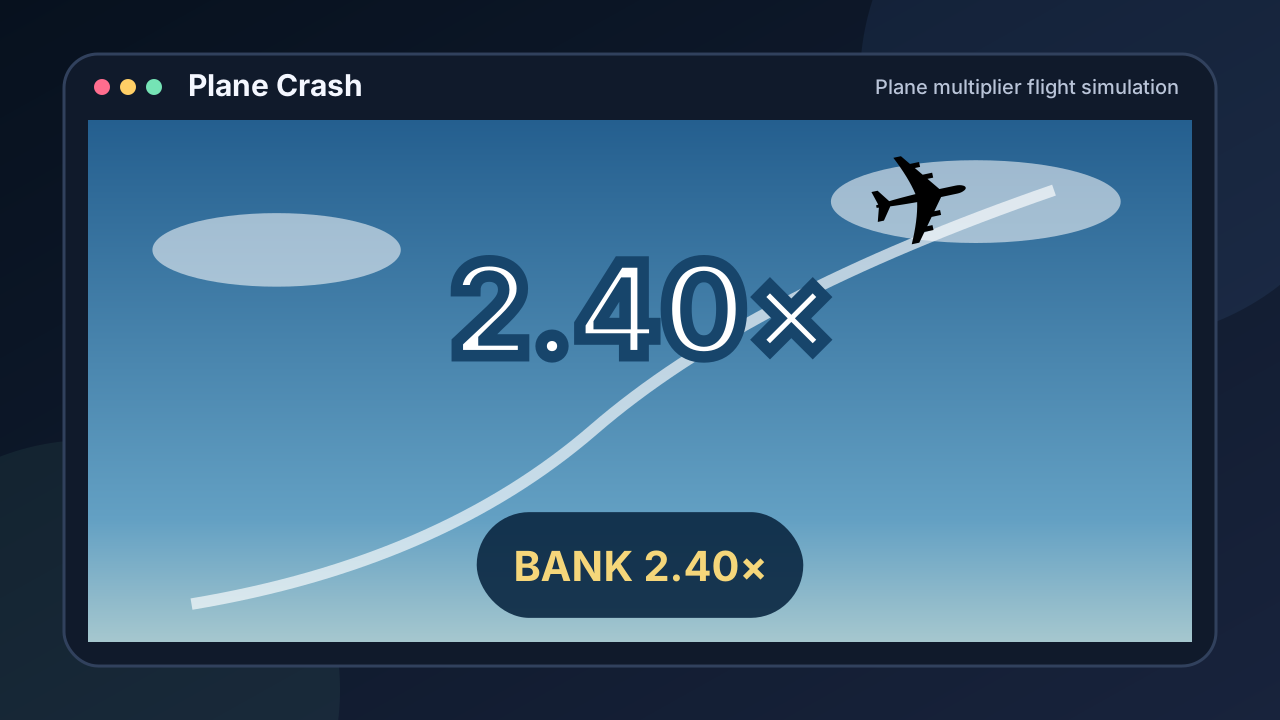
Rocketship Crash is the aggressive tuning of the crash format. It doubles every 1.75 seconds against Plane Crash’s three, tops out at 250× instead of 50×, and returns 94% rather than 96%. You are buying a much longer tail and paying two percentage points for it.
Typical session: 1–5 minutes.
The practice-credit balance stays in this browser. It has no cash value and is not connected to accounts, points, rewards, cosmetics, or leaderboards. No download is required. Read the safety and compatibility facts.
Playing the fast variant
The same format, tuned harder
You stake before launch, a multiplier climbs from 1.00, and banking returns your stake times the current figure. If the rocket is lost before you bank, the stake goes with it.
The climb doubles every 1.75 seconds. That reaches 4× in three and a half seconds and 8× in a little over five — roughly the pace at which Plane Crash is still approaching 3×. The whole game is compressed.
The ceiling is 250×, five times higher than the other table. Reaching it banks at that figure. As with any crash game, the endpoint is drawn before the launch animation starts.
The long tail is the only reason to be here
Every cash-out target returns the same 94% on average, so there is no optimal number. What the higher ceiling changes is what is possible at all: a 250× result exists here and simply cannot occur on the 50×-capped table, however long you hold.
That is the honest case for this variant. If you want the possibility of a very large multiplier, this is the table that has one, and the two percentage points of extra house edge is the price. If you do not specifically want that tail, the other table returns more for the same game.
Practically, the compressed pace makes manual timing much harder. Reacting to a number that doubles every 1.75 seconds is unreliable above about 5×, so decide your target during the countdown and act on the number rather than on the visuals. Anything above 10× here is effectively a pre-committed bet, not a judgement call.
- Set your target before launch — at this pace the difference between 8× and 16× is under two seconds.
- Treat a lost round as ordinary; the higher edge means slightly more of them than on the slower table.
- If you find yourself reacting rather than executing a plan, the slower table is the better fit.
What the extra two percent buys
The two crash tables share one engine and differ only in four tuned constants. Setting them side by side makes the trade explicit rather than something you have to infer from feel.
Read the bottom row carefully, because it is the one that changes how the game plays rather than how it pays. Reaching 16× here takes seven seconds against twelve on the slower table, and that compression is what pushes high targets out of reach of manual timing. The ceiling and the edge are the headline numbers; the doubling interval is the one you will actually feel every round.
| Setting | Rocketship Crash | Plane Crash |
|---|---|---|
| Theoretical return | 94% | 96% |
| Multiplier ceiling | 250× | 50× |
| Doubling time | 1.75 seconds | 3 seconds |
| Time to reach 16× | 7 seconds | 12 seconds |
Common mistakes
The speed of this variant makes two errors much easier to fall into than on the slower table.
- Trying to react to the multiplier. Above roughly 5× the number changes faster than a reaction can reliably track, so manual timing quietly becomes guesswork.
- Assuming the higher ceiling means better value. It returns less, not more — 94% against 96% — and the ceiling only widens the range of outcomes.
- Reading previous rounds for a pattern. Each endpoint is drawn independently before its launch; nothing carries between rounds.
- Playing here to learn the format. The slower table is the same game with more thinking time and a better return.
What is different about this version
This table and Plane Crash run on identical code with different constants — the edge, the ceiling, and the doubling interval are configuration rather than separate implementations. That is why the comparison above is exact: the two games are provably the same mathematics with different parameters, not two approximations of a genre.
The endpoint is resolved from one random draw before the launch renders, so the compressed animation cannot cost you a bank that already registered. At this pace that guarantee matters more than it does on the slower table, because the margin between intended and actual cash-out is measured in fractions of a second.
Common questions about Rocketship Crash
Which crash table should I play?
Plane Crash returns 96% against this table’s 94%, so it is better value. Choose Rocketship only if you specifically want the 250× ceiling, which the slower table cannot reach at all.
How much faster is it?
It doubles every 1.75 seconds rather than every three, so it reaches 16× in about seven seconds where the other table needs twelve. The whole round is compressed by roughly forty percent.
Can I really reach 250×?
It is the ceiling, so yes in principle — but the odds of surviving that long are correspondingly tiny. The higher cap widens the range of outcomes without improving the average, which stays at 94%.
Is a high target better than a low one?
No. Every target has the same expected return because the distribution is memoryless. A high target trades frequent small wins for rare large ones, leaving the average untouched.
Written by the Silverweb Games team from this game’s own implementation. Last reviewed July 31, 2026.