Quick help
Plane multiplier flight simulation
- Choose a practice bet and Launch. The multiplier doubles every three seconds along a pre-resolved flight.
- The same primary button becomes Bank. Press it before the neutral “flight ended” result to return bet × multiplier.
- The idealized distribution returns 96% before its 50× cap. Reaching the cap forces a successful maximum bank.
- The shared Pause control, a hidden tab, or window blur freezes elapsed time without changing the resolved ending.
Controls: Select bet · Launch / Bank
Choose a practice bet and launch. Bank before the flight ends.
Plane Crash rules and flight math
The complete end multiplier is resolved before launch with browser cryptographic randomness. The curve doubles every 3 seconds. The vector flight follows the live multiplier but never reveals the hidden end point. Bank before the neutral signal-loss result.
Idealized return is 96%, before the forced successful bank at the 50× cap. Hidden tabs, window blur, and the page pause control freeze the flight.
Rules version: crash-flight-v1.
How to play
Plane multiplier flight simulation
Launch a steady multiplier flight, then bank before its pre-resolved neutral ending or reach the forced 50× cap.
- Choose a practice bet and Launch. The multiplier doubles every three seconds along a pre-resolved flight.
- The same primary button becomes Bank. Press it before the neutral “flight ended” result to return bet × multiplier.
- The idealized distribution returns 96% before its 50× cap. Reaching the cap forces a successful maximum bank.
- The shared Pause control, a hidden tab, or window blur freezes elapsed time without changing the resolved ending.
Controls
Plane Crash controls
About this game
The gentler of the two crash tables
Plane Crash is a cash-out game: a multiplier climbs from 1.00 and you bank it before the flight ends. It doubles every three seconds and caps at 50×, with a 96% theoretical return — making it the slower, higher-returning of the two crash tables here, and the better one to learn on.
Typical session: 1–5 minutes.
The practice-credit balance stays in this browser. It has no cash value and is not connected to accounts, points, rewards, cosmetics, or leaderboards. No download is required. Read the safety and compatibility facts.
Timing a cash-out
A climbing multiplier and a hidden endpoint
You stake before the flight starts. A multiplier begins at 1.00 and climbs continuously; cashing out at any moment returns your stake multiplied by whatever it showed when you pressed. If the flight ends before you cash out, the stake is lost.
The climb is exponential rather than linear — the multiplier doubles every three seconds. So it takes three seconds to reach 2×, six to reach 4×, and nine to reach 8×. Early gains are slow and late gains accelerate sharply.
The crash point is decided before the flight is drawn, not while it is running. It is generated from a single random draw at the start of the round, which means nothing you do during the flight influences when it ends.
The multiplier is capped at 50×. Reaching the cap pays out at that ceiling rather than continuing.
No cash-out point is better than any other
This is worth stating plainly because crash games attract more systems than almost anything else. The distribution is memoryless: the chance of the flight surviving from 2× to 4× is the same as the chance of surviving from 10× to 20×. Every cash-out target has the same expected return, and that return is 96%.
What your target genuinely changes is variance. Cashing out at 1.5× wins often and pays little; holding for 20× almost never lands but pays enormously when it does. Neither is better value — you are choosing the shape of your results, not improving them.
The one real skill is mechanical rather than strategic. Because the climb is exponential, the multiplier moves slowly at first and then very quickly, so a reaction-based cash-out at a high multiplier is far harder to hit than at a low one. If you are targeting 10× or beyond, decide the number in advance rather than watching and reacting.
A round can also end instantly at 1.00×, before the climb is visible at all. That outcome is part of the distribution rather than a fault, and it is why no cash-out plan can guarantee a return.
How this table compares to its sibling
The two crash tables here share an engine but are tuned differently, and the differences are substantial rather than cosmetic. Plane Crash is the slower, safer, higher-returning of the two.
The slower doubling is the practically important difference. Three seconds per double means the multiplier is still readable at 8× and 16×, so a manual cash-out at those levels is a decision you can actually execute rather than a reflex you have to hope lands. Combined with the higher return, that makes this the sensible table to learn the format on before deciding whether the longer tail elsewhere is worth two percentage points.
| Setting | Plane Crash | Rocketship Crash |
|---|---|---|
| Theoretical return | 96% | 94% |
| Multiplier ceiling | 50× | 250× |
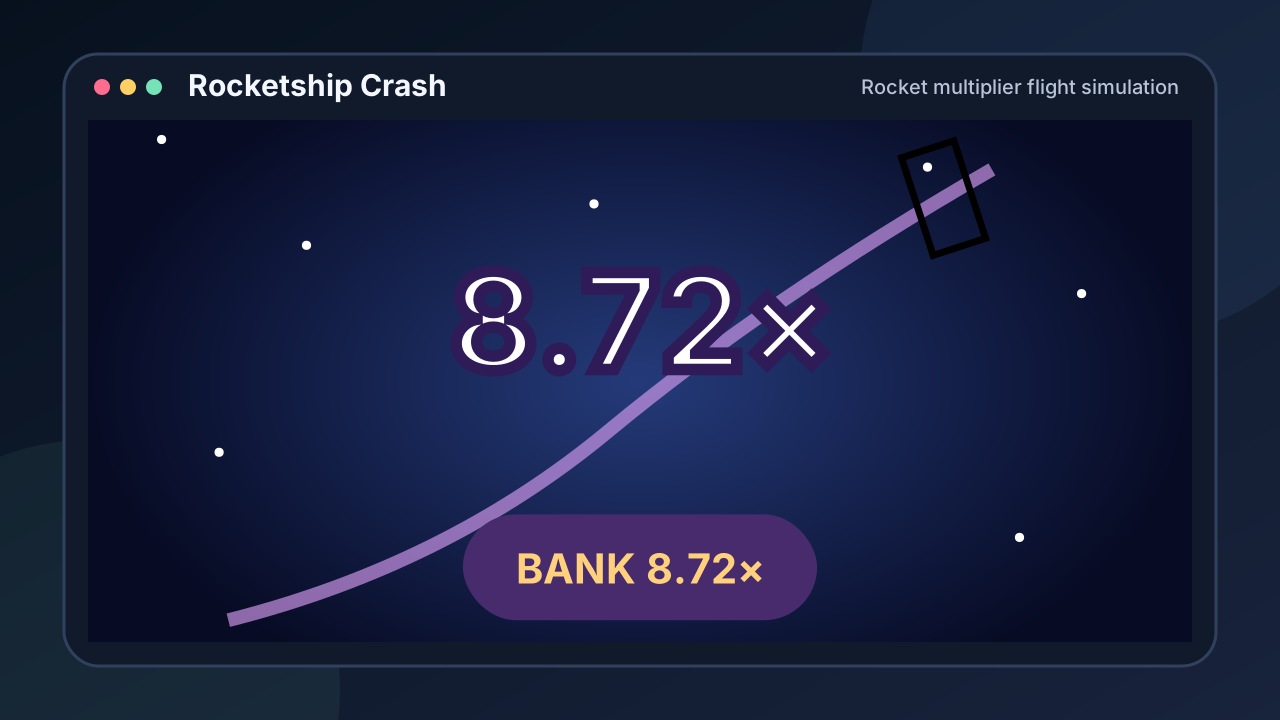
| Doubling time | 3 seconds | 1.75 seconds |
| Time to reach 8× | 9 seconds | 5.25 seconds |
Common mistakes
Crash games produce more confident false theories than any other format.
- Reading the history of previous flights. Each crash point is drawn independently at the start of its round; a run of early endings says nothing about the next one.
- Chasing losses with a higher target. Raising your cash-out point after a loss increases variance without changing the 96% expected return by a single percentage point.
- Reacting rather than deciding. The exponential climb means high multipliers arrive fast — pick your number before the flight starts.
- Treating an instant end as a glitch. Ending at 1.00× is a legitimate outcome of the distribution, not a failure of the round.
What is different about this version
The crash point is resolved from a single random draw before the animation begins, using the standard inverse-distribution formula with the house edge applied as an explicit constant. Because the result already exists before the plane is drawn, a slow device, a dropped frame, or a backgrounded tab cannot change when the round ends or cost you a cash-out that had already registered.
The theoretical return is a published constant rather than a target approached by tuning. Both crash tables expose their edge, ceiling, and doubling interval as named values, which is what makes the comparison in the table above verifiable rather than a claim.
Common questions about Plane Crash
Is there a best multiplier to cash out at?
No. The distribution is memoryless, so every target carries the same 96% expected return. Choosing a lower target wins more often for less; a higher one wins rarely for more. The average is identical.
How fast does the multiplier climb?
It doubles every three seconds, so 2× arrives at three seconds, 4× at six, and 8× at nine. The growth is exponential, which is why high multipliers appear to arrive suddenly.
Can the round end immediately?
Yes. A flight can end at 1.00× before any meaningful climb happens. That is a normal outcome of the underlying distribution rather than a bug, and it is why no cash-out strategy can be made safe.
How does this differ from Rocketship Crash?
Plane Crash returns 96% against Rocketship’s 94%, caps at 50× rather than 250×, and doubles every three seconds instead of every 1.75. It is materially slower and returns more.
Written by the Silverweb Games team from this game’s own implementation. Last reviewed July 31, 2026.