Quick help
Risk-reveal grid practice simulation
- Choose 3, 5, or 8 overloads, set a practice bet, and arm the securely shuffled 5×5 field.
- Reveal one hidden cell at a time. Each safe reveal protects a larger multiplier; an overload ends the round.
- Lock after any safe reveal. There are no clues or flags—every unrevealed cell has the same published chance.
Controls: Choose charge · reveal cells · lock
How to play
Risk-reveal grid practice simulation
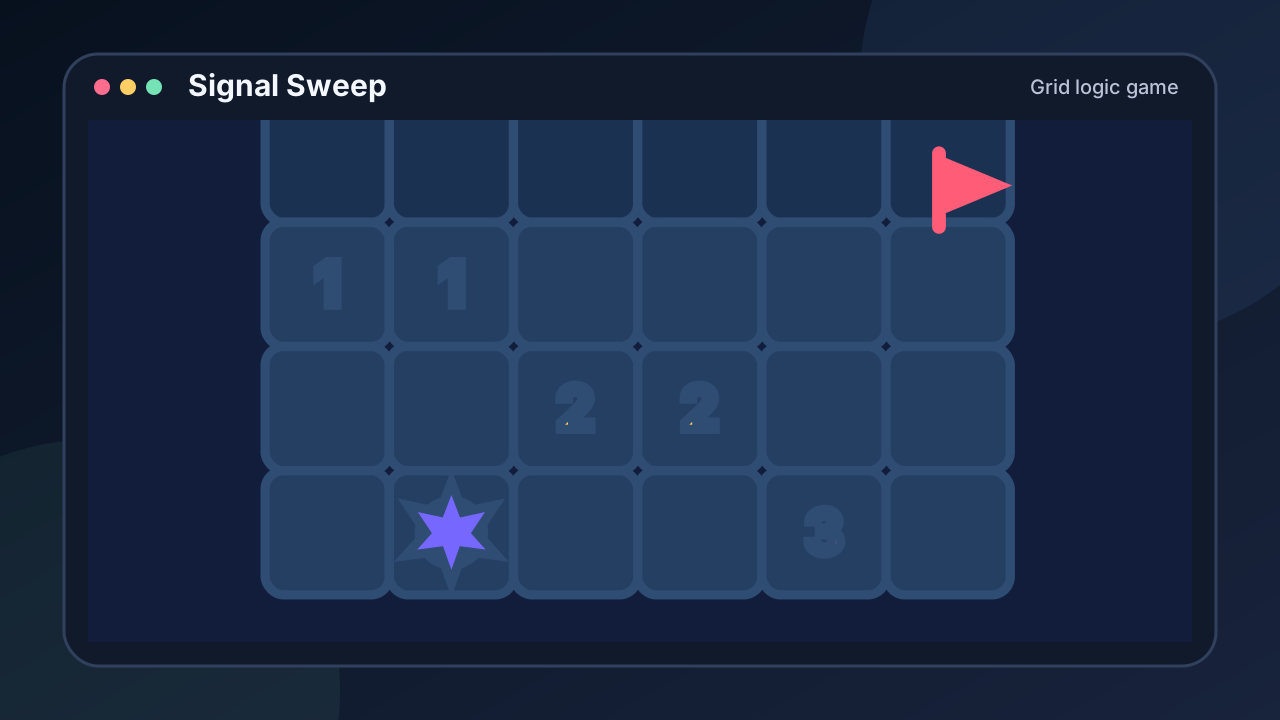
Reveal a charged 5×5 field one cell at a time, then lock the growing return before a hidden overload breaks the chain.
- Choose 3, 5, or 8 overloads, set a practice bet, and arm the securely shuffled 5×5 field.
- Reveal one hidden cell at a time. Each safe reveal protects a larger multiplier; an overload ends the round.
- Lock after any safe reveal. There are no clues or flags—every unrevealed cell has the same published chance.
Controls
Reactor Grid controls
About this game
You choose how many mines to hide
Reactor Grid is a twenty-five cell board where you pick how many overload cells are hidden — three, five, or eight — before you start revealing. More overloads means a steeper multiplier per safe reveal and a much shorter expected run. You set your own risk before the round begins.
Typical session: 1–6 minutes.
The practice-credit balance stays in this browser. It has no cash value and is not connected to accounts, points, rewards, cosmetics, or leaderboards. No download is required. Read the safety and compatibility facts.
Choosing your overload count
Twenty-five cells, and a number you pick
The grid holds twenty-five cells. Before revealing anything you choose how many of them conceal an overload: three, five, or eight. That choice is the whole game — it sets both your risk per reveal and how fast the multiplier climbs.
You then reveal cells one at a time. Every safe reveal increases your multiplier; hitting an overload ends the round and loses the stake. You can bank at any point after the first safe reveal.
Because cells are revealed without replacement, the odds change as you go. With five overloads, your first reveal is safe twenty times out of twenty-five; by your tenth reveal the remaining board is far more dangerous, because the safe cells have been used up faster than the overloads.
The danger accelerates, so plan the exit first
The critical thing to understand is that risk per reveal rises as you go. Early reveals are comfortably safe and late ones are not, because each safe cell you uncover removes a safe cell from the pool while every overload remains. Survival probability across a run falls much faster than the linear multiplier growth suggests.
That makes deciding your exit before you start the only sensible approach. Pick a number of reveals, take them, and bank — rather than assessing each reveal individually, which reliably leads to one more than you intended.
The three overload settings are genuinely different games rather than a difficulty slider. Three overloads gives long, gentle runs with modest multipliers. Eight gives very short runs and steep growth. All three carry the same theoretical return, so the choice is about the shape of your results, not their value.
- With eight overloads the board is nearly a third dangerous from the first click — treat three or four reveals as a full run.
- With three overloads the early reveals are safe enough that stopping too soon wastes the setting’s main advantage.
- The multiplier shown is what you would bank now; it is never a prediction of what the next reveal is worth.
How survival odds fall
Survival across a run is the product of each individual reveal’s safety, and because the pool shrinks that product falls away quickly. The figures below show why a modest-looking number of reveals becomes a long shot at the higher settings.
Read down a column rather than across a row. Within a single setting the decline is steep and accelerating — at five overloads, going from three reveals to eight cuts your survival chance by more than three quarters. That is the curve the multiplier is climbing against, and it is why a run that feels like it is going well can be much closer to ending than the growing number suggests.
| Reveals | 3 overloads | 5 overloads | 8 overloads |
|---|---|---|---|
| 3 | 66% | 48% | 24% |
| 5 | 50% | 29% | 9% |
| 8 | 30% | 11% | 1.5% |
| 10 | 20% | 5% | Under 1% |
Common mistakes
Every error here comes from treating the reveals as equally risky when they are not.
- Deciding whether to continue after each reveal. The multiplier always makes one more look worthwhile — set the exit before you begin.
- Assuming the odds hold steady. Cells are revealed without replacement, so the board becomes progressively more dangerous as safe cells are consumed.
- Reading eight overloads as merely harder. It is a different distribution entirely — short, steep runs rather than a tougher version of the same game.
- Thinking a higher overload count pays better. All three settings carry the same theoretical return; only the variance changes.
What is different about this version
The engine exposes a survival-probability function directly, computing the exact chance of surviving any given number of reveals at any overload count. That is unusual — most games of this type leave the player to guess at how the odds decay, and the decay is the entire game.
Overload positions are fixed when the round begins rather than decided as you click, so the game cannot move a mine under your cursor after the fact. The board you are revealing genuinely existed before your first reveal.
Common questions about Reactor Grid
Which overload count should I choose?
All three carry the same theoretical return, so pick by preference. Three gives long gentle runs with small multipliers; eight gives very short runs with steep ones. It is a variance choice, not a value one.
Do the odds stay the same as I reveal?
No, they get worse. Cells are revealed without replacement, so every safe reveal removes a safe cell while all the overloads remain — the board becomes progressively more dangerous as you go.
When should I cash out?
At a number you decided before starting. The displayed multiplier always makes one more reveal look attractive, which is exactly why judging it in the moment tends to end runs prematurely.
Are the overloads placed before or during the round?
Before. Positions are fixed when the round begins, so the game cannot relocate one in response to where you click. The board you reveal is the board that already existed.
Written by the Silverweb Games team from this game’s own implementation. Last reviewed July 31, 2026.