Quick help
Pai Gow Tiles practice table
- Deal four tiles from the complete 32-tile set, then choose exactly two for the low hand.
- Pairs outrank Wongs, Wongs outrank Gongs, and Gongs outrank point totals. Gee Joon can count as 3 or 6.
- House Way starts with a deterministic suggestion following pair, Wong, Gong, and strong-point priorities; you may override it.
- Win both comparisons for even money less 5% commission. Split them to push; exact copies go to the dealer.
Controls: Select bet · deal · choose two low tiles
Dealerfour tiles face down
Youfour tiles
Choose a practice bet, then deal four tiles.
Pai Gow Tiles rules and House Way
- The 32 black-tile set contains 16 exact or mixed pairs. Each side sets a high and low two-tile hand. Pairs outrank Wongs, which outrank Gongs, then point totals; Gee Joon can count as 3 or 6.
- Both hands must beat the dealer to win. One win and one loss pushes. Exact copies go to the dealer. Wins pay even money less 5% commission.
- House Way priority is Supreme Pair; then pairs, Wong, or Gong; then making 9, 8, or 7; otherwise the strongest balanced legal split.
How to play
Pai Gow Tiles practice table
Learn pairs, Wongs, Gongs, points, Gee Joon values, dealer copies, and an editable House Way suggestion.
- Deal four tiles from the complete 32-tile set, then choose exactly two for the low hand.
- Pairs outrank Wongs, Wongs outrank Gongs, and Gongs outrank point totals. Gee Joon can count as 3 or 6.
- House Way starts with a deterministic suggestion following pair, Wong, Gong, and strong-point priorities; you may override it.
- Win both comparisons for even money less 5% commission. Split them to push; exact copies go to the dealer.
Controls
Pai Gow Tiles controls
About this game
A ranking order that predates card decks
Pai Gow Tiles is the original game the poker version was built from. Thirty-two Chinese dominoes, split into two hands of two, with a ranking order that is memorised rather than derived — and one pair of tiles that can count as either three or six depending on which serves you better.
Typical session: 3–12 minutes.
The practice-credit balance stays in this browser. It has no cash value and is not connected to accounts, points, rewards, cosmetics, or leaderboards. No download is required. Read the safety and compatibility facts.
Reading the tile rankings
Thirty-two tiles, four cards each hand
The set contains sixteen kinds of tile, two of each, for thirty-two in total. You receive four and split them into a high hand and a low hand of two tiles apiece, with the high hand required to rank at least as high as the low.
Ordinary hands are scored by points: add the two tiles’ values and take the last digit, so nine is the best ordinary total and zero the worst. Above that sit three special categories — Gong, Wong, and pairs — which beat any point total.
Both your hands are compared against the dealer’s. Winning both wins the bet, losing both loses it, and a split is a push. Winning bets pay even money less a five percent commission.
The order is memorised, not calculated
The central difficulty of pai gow tiles is that pair rankings do not follow from tile values. The pair order is a fixed traditional sequence, and it does not correlate with how many points the tiles are worth. Two tiles worth very little can form a pair that outranks a pair of high-value tiles, and there is no rule to derive this from — it simply has to be learned.
Pairs beat everything, so recognising that you hold one is the first thing to check every hand. After that, look for Wong and Gong: a privileged tile paired with a tile totalling nine makes Wong, and with eight makes Gong. Both beat any ordinary point total.
The Gee Joon tiles are the game’s wildcard and the reason experienced players study it. They can count as either three or six, whichever produces the better hand, so a holding that looks like a poor total may in fact be a strong one. Always compute both options before setting a hand containing one.
As with the poker version, balance beats concentration. Two moderate hands win more often than one excellent hand and one hopeless one, because a split result returns your stake rather than winning it.
Hand categories, strongest first
The categories above are absolute: any pair beats any Wong, any Wong beats any Gong, and any of those beats the best possible point total of nine. Within the point totals, only the last digit matters, so a total of twelve scores two.
This is why the game rewards recognition over calculation. There are only sixteen kinds of tile and a fixed set of special combinations, so an experienced player identifies a hand’s category instantly rather than adding anything up. The arithmetic is trivial once you know which category you are in; the difficulty is entirely in knowing where a given pair sits in the traditional order.
| Category | What it is |
|---|---|
| Pair | Two tiles of the same kind — ranked by a fixed traditional order |
| Wong | A privileged tile with a tile totalling nine |
| Gong | A privileged tile with a tile totalling eight |
| Points | Last digit of the two tiles’ combined value, nine high |
Common mistakes
This is the least intuitive game on the floor, and its errors are specific to it.
- Assuming pair rank follows tile value. It does not — the pair order is traditional and arbitrary, and a low-value pair can outrank a high-value one.
- Missing the Gee Joon flexibility. Those tiles count as three or six, whichever helps, so a hand that looks weak may be considerably better than it appears.
- Adding totals above ten. Only the last digit counts, so twelve is a two and eleven is a one — a high raw sum can be a terrible hand.
- Stacking the high hand. Both hands must win to collect, so a superb high hand next to a hopeless low one is a push at best.
What is different about this version
The Gee Joon dual value is implemented properly — the evaluator considers both the three and the six and takes whichever produces the stronger hand, rather than fixing it at one value. That flexibility is the most distinctive rule in the game and the one simplified versions most often drop.
Pair strength is stored as its own explicit ordering separate from point value, because the traditional ranking genuinely cannot be derived from the tiles’ numbers. Wong and Gong are detected as distinct categories rather than folded into point totals, so the hierarchy matches how the game is actually played.
Common questions about Pai Gow Tiles
Why does a low-value pair beat a high-value one?
Because pair rankings follow a fixed traditional order that has nothing to do with the tiles’ point values. There is no rule to derive it from — the sequence is memorised, and it is the main barrier to learning the game.
What are the Gee Joon tiles?
The game’s flexible pair. They count as either three or six, whichever gives the better hand, so always work out both options before setting a hand that contains one — it frequently turns a weak-looking holding into a strong one.
What is the best possible ordinary hand?
Nine points. Only the last digit of the combined value counts, so a total of nineteen is also nine while a total of ten is zero. Pairs, Wong, and Gong all beat any point total regardless.
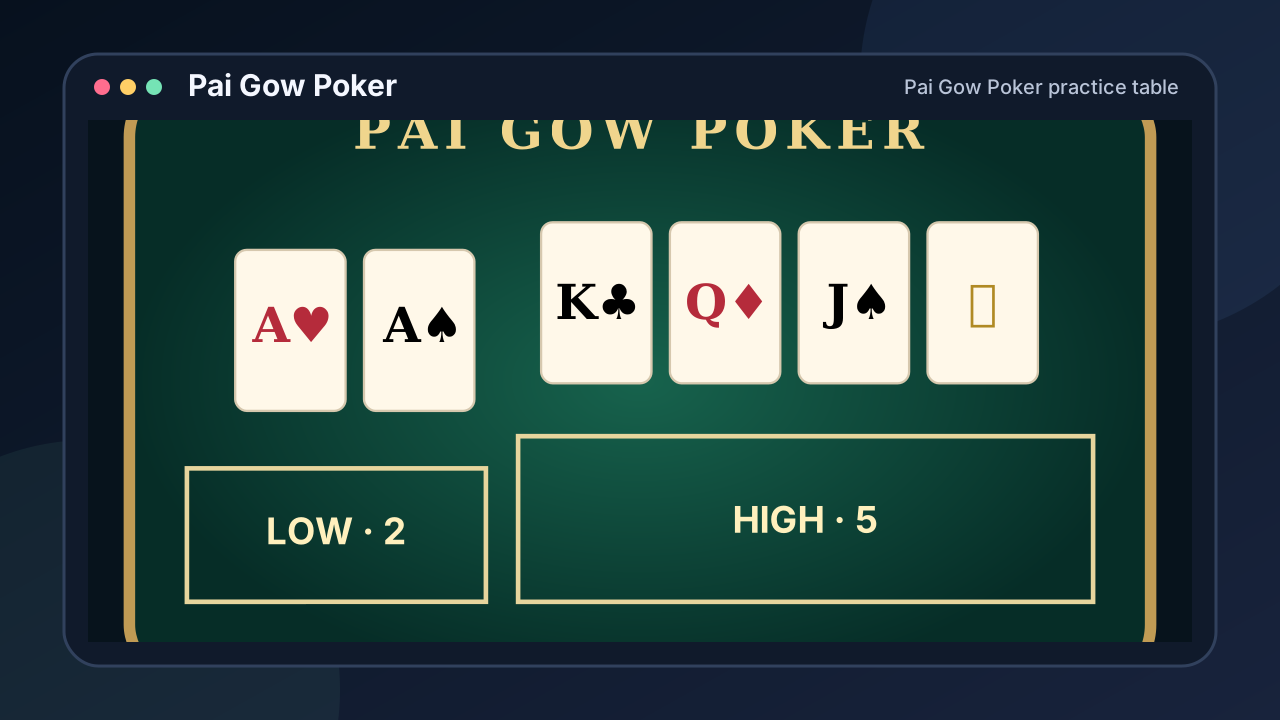
How is this different from Pai Gow Poker?
Pai Gow Poker is the modern card adaptation of this game. The two-hand structure and the push-on-a-split rule carry over, but tiles use a traditional ranking order and a much smaller set of possible hands.
Written by the Silverweb Games team from this game’s own implementation. Last reviewed July 31, 2026.