Quick help
Pai Gow Poker practice table
- Choose a practice bet and deal seven cards. The joker is an ace unless it completes a straight, flush, or straight flush.
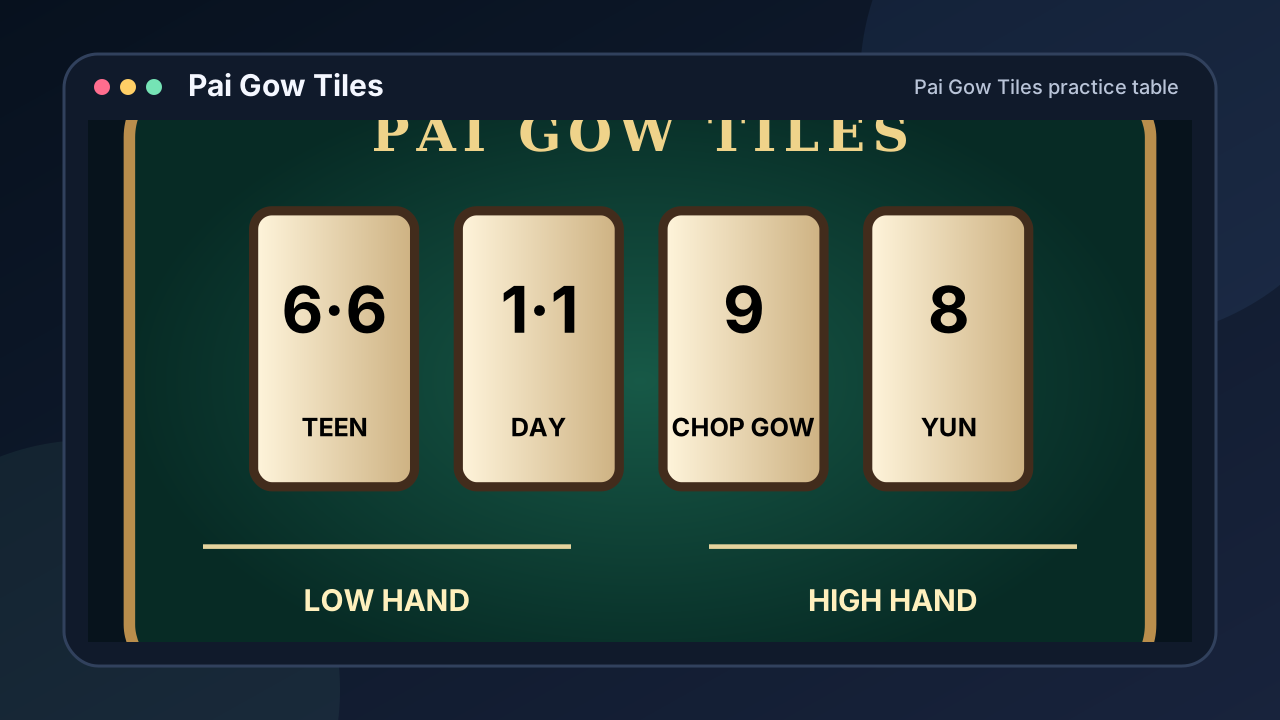
- Exactly two cards form the low hand; the other five form the high hand. The high hand must rank above the low hand.
- House Way starts with a deterministic suggestion. Tap cards to override it, then Set hands.
- Win both comparisons for even money less 5% commission. Split the comparisons to push; exact copies go to the dealer.
Controls: Select bet · deal · choose two low cards
Dealerseven cards face down
Youseven cards
Choose a practice bet, then deal seven cards.
Pai Gow Poker rules and House Way
- Set a five-card high hand and two-card low hand. The high hand must outrank the low hand. The joker is an ace unless it completes a straight, flush, or straight flush; A-2-3-4-5 is the second-highest straight here.
- Both hands must beat the dealer to win. One win and one loss pushes. Exact copies go to the dealer. Wins pay even money less 5% commission.
- The posted House Way searches every legal split and prioritizes a useful low hand, then the strongest high hand. It is a suggestion and can be overridden.
How to play
Pai Gow Poker practice table
Set five-card high and two-card low hands with a semi-wild joker, editable House Way guidance, and dealer copies.
- Choose a practice bet and deal seven cards. The joker is an ace unless it completes a straight, flush, or straight flush.
- Exactly two cards form the low hand; the other five form the high hand. The high hand must rank above the low hand.
- House Way starts with a deterministic suggestion. Tap cards to override it, then Set hands.
- Win both comparisons for even money less 5% commission. Split the comparisons to push; exact copies go to the dealer.
Controls
Pai Gow Poker controls
About this game
Win both hands or nothing happens
Pai Gow Poker splits seven cards into a five-card hand and a two-card hand, both of which must beat the dealer’s equivalents to win. Splitting one and losing one is a push, which is why most hands end with nothing changing — this is the slowest-moving game in any casino, by design.
Typical session: 3–12 minutes.
The practice-credit balance stays in this browser. It has no cash value and is not connected to accounts, points, rewards, cosmetics, or leaderboards. No download is required. Read the safety and compatibility facts.
Setting a seven-card hand
Two hands, two comparisons, three outcomes
You receive seven cards and split them into a five-card high hand and a two-card low hand. The mandatory constraint is that the five-card hand must rank higher than the two-card hand — you cannot put your best pair in the two-card hand and a weaker holding in the five.
Both of your hands are then compared against the dealer’s two. Winning both wins the bet. Losing both loses it. Winning one and losing the other is a push, and your stake is returned untouched.
Ties go to the dealer. A copy — an identical hand — counts as a dealer win for that comparison, which is a meaningful part of the house edge and the reason a genuine tie is never in your favour.
A winning bet pays even money less a five percent commission, which is the other half of the house edge.
The push is the point
Because a split decision returns your stake, the dominant outcome in pai gow poker is nothing happening. That shapes the entire strategy: you are not trying to maximise the strength of your five-card hand, you are trying to make both hands strong enough to win together.
The standard approach is the house way — the fixed rule set the dealer follows. With one pair, keep the pair in the five-card hand and put your two highest remaining cards in the two-card hand. With two pair, the decision depends on how high the pairs are: splitting them so each hand has a pair is often better than keeping both together and leaving the two-card hand weak.
The most common self-inflicted error is stacking everything into the five-card hand. A monstrous five-card hand alongside a two-card hand of seven-high wins one comparison and loses the other — a push. Two moderately strong hands beat one strong and one weak nearly every time.
With no pair at all, put your highest card in the five-card hand and the next two highest in the two-card hand. It feels weak because it is, but balancing is still better than concentrating.
Why so many hands push
The three-outcome structure combined with the copy rule means the distribution of results is heavily weighted toward the middle. A large share of hands are pushes, which makes bankrolls last a very long time and makes the game feel much less volatile than its house edge implies.
That has a practical consequence worth naming. Because most hands return your stake, the edge is collected slowly across many more hands than a game like blackjack needs. Players often read the frequent pushes as evidence that the game is close to fair, when in fact the same percentage is being taken — just spread thinly enough that it is hard to notice over a short session.
| Result | Settlement |
|---|---|
| Win both hands | Even money, less 5% commission |
| Win one, lose one | Push — stake returned |
| Lose both hands | Stake lost |
| Copy on either hand | That comparison goes to the dealer |
Common mistakes
Every one of these produces the same failure: one strong hand and one that cannot win.
- Loading the five-card hand. A huge five and a weak two is a push at best, and the strength you piled into the five did nothing.
- Keeping two pair together. Two pair in the five-card hand often leaves the two-card hand unable to win; splitting them gives both hands a chance.
- Forgetting copies lose. An identical hand goes to the dealer, so aiming to merely match rather than beat is not good enough.
- Reading pushes as wasted hands. The push rate is intrinsic to the game — it is why a session lasts so long, not a sign of poor play.
What is different about this version
The copy rule is implemented properly: identical hands resolve to the dealer on that comparison rather than being scored as a tie or a player win. It is a small rule that contributes meaningfully to the house edge, and dropping it would misrepresent the game.
Commission is applied as an exact five percent on winning bets only, and the interface refuses to let you set an illegal split rather than accepting it and penalising you afterwards — the same protection a live dealer provides when checking a player’s setting.
Common questions about Pai Gow Poker
Why do so many hands push?
Because you must win both comparisons to win the bet. Winning one and losing the other returns your stake, and that split outcome is the most common result — which is what makes pai gow the slowest-moving game on any floor.
How should I split my seven cards?
Balance rather than concentrate. Keep a pair in the five-card hand with your two highest remaining cards in the two, and consider splitting two pair so both hands can win. A monster five alongside a weak two only ever produces a push.
What happens if my hand exactly matches the dealer’s?
The dealer wins that comparison. Copies always go to the house, which means matching is not enough — you have to genuinely beat both of the dealer’s hands to win the bet.
Why is there a commission on wins?
It is five percent taken from winning bets, and together with the copy rule it makes up the house edge. Without them the three-outcome structure would be close to break-even for the player.
Written by the Silverweb Games team from this game’s own implementation. Last reviewed July 31, 2026.