Quick help
Ricochet shooting game
- Rotate the cannon with Left and Right while every robot waits in place.
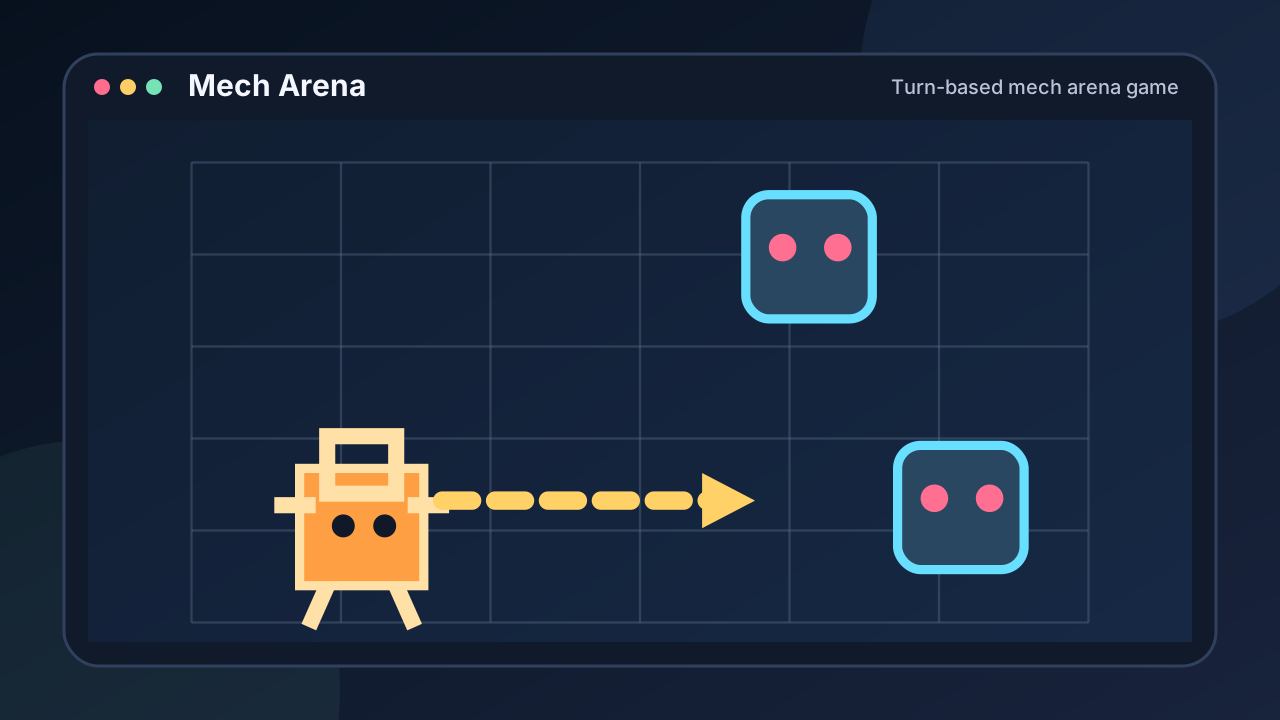
- Press Space to fire; the targeting line shows banks off both arena walls and circular robot armor.
- Clear each wave before your shot supply runs out, chaining robot ricochets for combo points.
Controls: ← → aim · Space fire · Touch buttons
Bankshot Bots
Plot wall ricochets and shut down every robot with a limited magazine.
How to play
Ricochet shooting game
Line up wall-bouncing laser shots and clear compact robot arenas.
- Rotate the cannon with Left and Right while every robot waits in place.
- Press Space to fire; the targeting line shows banks off both arena walls and circular robot armor.
- Clear each wave before your shot supply runs out, chaining robot ricochets for combo points.
Controls
Bankshot Bots controls
About this game
Four levels solved with ricochets
Bankshot Bots is an angle puzzle: fire a beam that ricochets off walls to hit every robot in the arena, using a strict shot allowance. Aim is set in fixed two-degree increments across a 140-degree arc, and the beam survives up to five bounces — so the solution is geometry, not reflexes.
Typical session: 2–5 minutes.
This browser stores recent play, favorites, preferences, and supported best scores. An account is optional. No download is required. Read the safety and compatibility facts.
Thinking in ricochets
A fixed arc, fixed steps, and five bounces
You fire from a fixed origin at the bottom of the arena. Aim swings 70 degrees either side of straight ahead — a 140-degree arc — and moves in two-degree steps, which gives you exactly 71 distinct angles rather than a continuous sweep.
The beam ricochets off the arena walls and carries on. It survives up to five bounces before expiring, so a single shot can cross the arena several times and strike robots that have no direct line to your position at all.
Each level sets its own shot allowance and robot arrangement. The first two levels give four shots and the later ones five, and robots are placed so that at least one of them is unreachable without banking.
Work backwards from the robot
The productive way to solve these is in reverse. Pick the robot you cannot hit directly, look at which wall sits near it, and work out the angle that would arrive there off that wall. Then check whether that outgoing angle is available in the two-degree grid. Searching forwards by sweeping the aim and watching where the beam goes is far slower and rarely finds the multi-bounce solutions.
The single biggest scoring idea is that one beam can hit several robots. Because the beam continues after a strike and survives up to five bounces, a well-chosen angle can clear two or three robots in one shot. With shot allowances as tight as four, clearing the level often requires at least one multi-hit shot rather than being merely a bonus.
Reflections are mirror-symmetric, so the classic technique applies: imagine the arena reflected across the wall you intend to bank off, draw a straight line from your origin to the robot’s mirrored position, and the angle of that straight line is the angle you need. That converts a bounce problem into a line-of-sight problem.
The four levels
The levels escalate in both robot count and geometric awkwardness rather than in speed. Loading Dock and Assembly Line each allow four shots; Mainframe allows five, because its arrangement genuinely needs the extra attempt.
The shot allowance is the whole constraint. Since every level places at least one robot without a direct line, the effective budget is tighter than the raw number suggests: some of your shots must do double duty.
Robots also vary in size, and a larger body is a more forgiving target for a beam arriving after several bounces, where a small angular error has been magnified across the whole path. When a level offers a choice of which robot to take on the far end of a long ricochet, the bigger one is the safer bet.
| Level | Shots | What it tests |
|---|---|---|
| Loading Dock | 4 | Single banks off a near wall |
| Assembly Line | 4 | Lining up two robots on one beam |
| Mainframe | 5 | Multi-bounce routes to shielded positions |
Common mistakes
The common thread is treating each robot as its own separate shot.
- Firing one shot per robot. With four shots and robots that need banking, a level frequently cannot be cleared without at least one beam that takes out two.
- Sweeping the aim to find a solution. With 71 discrete angles, working backwards from the target wall is far faster than searching forwards and watching where the beam lands.
- Forgetting the beam continues after a hit. A struck robot does not stop the beam, so aiming at the nearest one first can waste the rest of a perfectly good path.
- Planning past five bounces. The beam expires after its fifth ricochet, so any route needing a sixth simply does not exist.
What is different about this version
Aim is quantised to two-degree steps rather than being continuous. That is a deliberate design decision: it makes every solution exactly reproducible and removes pixel-hunting entirely. A solution you find once can be repeated precisely, and no level can be cleared by luck with a fractionally different angle.
The beam has a real radius rather than being an infinitely thin ray, so contact is decided by genuine overlap with a robot’s body rather than by an exact-line test. That makes near-misses look and behave like near-misses instead of registering as hits.
Common questions about Bankshot Bots
How many times can the beam bounce?
Five. After the fifth ricochet the beam expires, so any route that would need a sixth bounce is not a valid solution no matter how good the angle looks.
Can one shot hit more than one robot?
Yes, and it usually has to. The beam continues after striking a robot, so lining several up on one path is often the only way to clear a level within its shot allowance.
Why can I not aim exactly where I want?
Aim moves in fixed two-degree steps across a 140-degree arc, giving 71 possible angles. That is intentional — it makes every solution exactly reproducible instead of requiring pixel-precise aiming.
How do I work out a bank shot?
Mirror the arena across the wall you want to bounce off, then draw a straight line from your firing position to the robot’s mirrored location. The angle of that line is the angle to fire, which turns the bounce into a simple line-of-sight problem.
Written by the Silverweb Games team from this game’s own implementation. Last reviewed July 31, 2026.
Related games
More arcade
Run complete
What next?
You opened a private challenge. No player or recipient identity is attached.